
Women’s Leadership in Iraq is Not Foreign or Modern, it is Indigenous.

International Women’s Day is a day for us to join voices with people around the world and shout our message for equal rights loud and clear. It is a day for celebrating all women, in all their diversities, embracing their facets and intersections of faith, race, ethnicity or disability. It is a day to celebrate those who came before us, those who stand beside us now, and those who will come after. It is a day for celebrating the achievements of women, whether social, political, economic or cultural. It is a day for recognizing how far we’ve come towards gender equality, but also how far we have left to go.
In Iraq, this struggle stretches back more than 4,000 years.
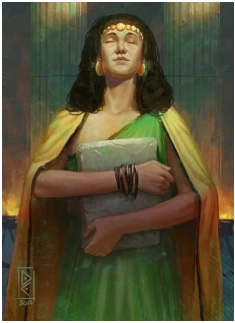
Enheduanna, appointed high priestess of the moon god Nanna in the city of Ur, was the daughter of King Sargon of Akkad and wielded immense religious, political, and economic influence. Writing in Sumerian, she composed revolutionary hymns devoted to the goddess Inanna, blending personal emotion with state theology and asserting a powerful female voice in a deeply patriarchal world. By signing her work, Enheduanna claimed intellectual authority in a way unprecedented in human history. Today, she stands not only as a historical figure, but as a symbol of Iraqi women’s resilience, agency, and enduring voice.

Women in ancient Mesopotamia were integral to statecraft, religion, and cultural life. Their authority, visible in roles such as priestesses, landholders, and intellectuals like Enheduanna, demonstrates that patriarchy was neither absolute nor static. This historical reality challenges modern assumptions about gender roles in the region and lays the groundwork for understanding contemporary restrictions on women not as cultural constants, but as regressions from earlier forms of female agency and power.
Understanding the status of women in Iraq requires attention to the country’s modern history, marked by prolonged conflict, instability, and weakened institutions. In the vacuum created by conflict and weakened institutions, informal power structures and customary norms often fill the gap, particularly in shaping women’s roles, creating tensions between customary norms and modern urban expectations. Social expectations often override legal protections, influencing access to education, employment, and public life. Many families and communities still pressure girls to treat schooling as secondary to marriage and motherhood rather than as a pathway to leadership or professional careers, while customs further restrict the types of work women can pursue and their participation in decision-making.


Historical precedent demonstrates that these constraints are not inevitable. Legal reforms following the July 14 Revolution of 1958 expanded women’s rights and public participation, yet wars, sanctions, and political instability subsequently eroded many of these gains, reinforcing reliance on tribal affiliations and customary practices. This history underscores that lasting social change requires not only legislation but also stable institutions capable of enforcing equality.
Today, Iraqi women continue to face interconnected political, economic, legal, and social challenges. Political participation remains often constrained: despite parliamentary quotas, women are underrepresented in senior decision-making positions, and patriarchal attitudes combined with political instability and limited cross-party support restrict their influence. Economic participation is similarly constrained, with labor force participation among the lowest in the Middle East and North Africa, most women employed in the public sector or agriculture, and discriminatory laws further limiting opportunities. Conflict and displacement have pushed many women into informal or precarious work, often as sole breadwinners. Violence against women and girls remains widespread, particularly domestic and psychological abuse, and Iraq still lacks a comprehensive domestic violence law. Penal code provisions continue to reinforce discrimination, for instance through mitigated sentences for “honor killings” and loopholes allowing perpetrators of sexual violence to evade prosecution by marrying their victims. Access to justice, shelter, and healthcare, including reproductive and mental health services, remains uneven, especially in rural or conflict-affected areas.
Addressing gender inequality in Iraq requires comprehensive legal, political, economic, and cultural reform. Proposed amendments to the Personal Status Law threaten to shift authority over marriage and inheritance from civil courts to religious institutions, potentially legitimizing unregistered marriages, worsening child marriage rates, and limiting women’s access to legal identity, social services, and inheritance. Meaningful progress depends on repealing discriminatory laws, enacting a strong domestic violence law, strengthening women’s political leadership beyond quotas, expanding access to formal employment and financial resources, and investing in culturally sensitive services for survivors, including mental health care. Equally critical is long-term cultural change, engaging men, religious leaders, and the media to challenge social norms that normalize discrimination and violence, so that equality becomes a lived reality rather than merely a legal promise.

Women’s resistance and advocacy in Iraq today reflect both continuity and hope, bringing the meaning of International Women’s Day back into sharp focus. Across the country, women’s rights organizations and civil society groups continue to push for legal reform, political inclusion, and protection from violence, often operating under intense pressure and repression. Their efforts align closely with international frameworks such as UN Security Council Resolution 1325, which recognizes women not merely as victims of conflict, but as essential peacebuilders and agents of change. Despite limited resources and political obstacles, activists have sustained underground shelters, community networks, and advocacy campaigns, offering protection and support where the state has failed to do so. These women work in different conditions and with different tools than their predecessors, yet their courage and insistence on having a voice echo the legacy of Enheduanna, affirming that women’s intellectual and political agency has always been part of Iraq’s story.

From the hymns of Enheduanna to the protests of modern Iraqi women, resilience has been both inherited and reinvented. Iraqi women’s struggle is not new; it is rooted in one of the world’s oldest civilizations. Progress today requires legal reform, cultural transformation, and genuine economic and political inclusion. International Women’s Day, therefore, is not merely symbolic—it is a call to action. The question is no longer whether Iraqi women are capable of leadership—history has already answered that—but whether society and the state will finally allow it.


Comments