
World Day to Combat Desertification and Drought

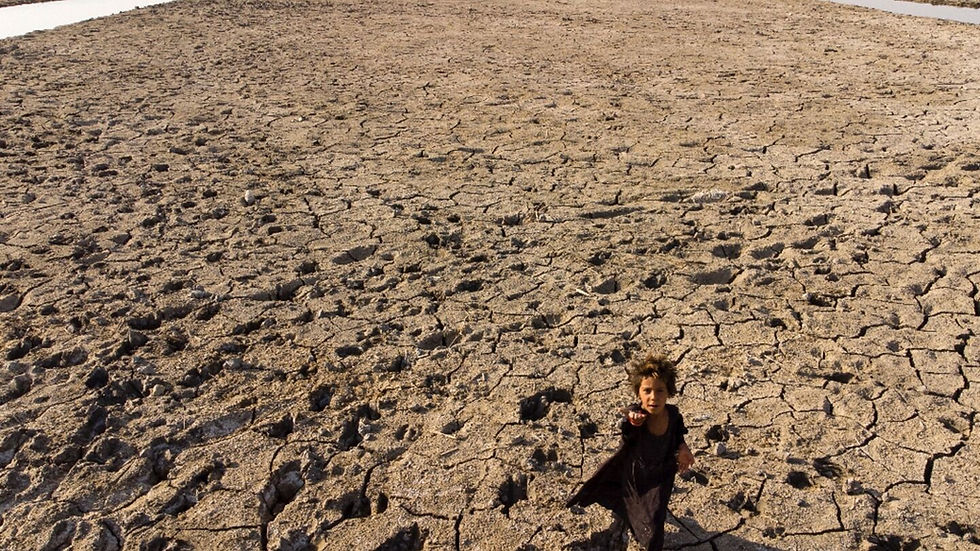
June 17th marked the World Day to Combat Desertification and Drought. This day compels reflection on a human-made phenomenon that is causing devastating consequences in Iraq, more than any other place on the planet.

What is desertification?
The 1994 UN Convention to Combat Desertification (UNCCD) has defined desertification as the “land degradation in arid, semi-arid and dry sub-humid areas resulting from various factors such as drought, deforestation, overgrazing, overcultivation, and inappropriate agriculture”.

Iraq’s geographical position puts the country in a particularly vulnerable place.
Approximately 90% of Iraq is located in a dry or semi-arid zone. The wide desertic area in the south-west receives less than 100 mm of rainfall per year and, under the impact of climate change, more areas are witnessing increasingly less rain. In addition, Iraq’s surface water is heavily dependent on neighbouring countries, with 80% of water originating from Turkey. Droughts and upstream dams strongly limit the water flow into Iraq. Once streams reach the country, underregulated water management exacerbates the issue. Coupled with global warming, which has brought intense heat waves, higher temperatures, and frequent dust and sandstorms, water resources are at their lowest level, making it heavily challenging to combat this phenomenon.

It has been estimated that 23% of the country has been desertified, while 55.5% of Iraq’s total area is threatened by desertification. Nearly 10,000 hectares of agricultural land are lost to the degradation of soil, desert encroachment, and salinity each year, threatening agriculture and livelihoods.
Even more, the quality of life of Iraqis is heavily impacted by the lack of water security. Rural residents and herders are forced to leave their sources of livelihood and have no choice but to resettle in urban areas. According to the International Organisation for Migration (IOM), about 74% of these climate migrants move to cities like Najaf, Basra, and Nasiriyah. Over 20,000 former residents of dried-up villages have been reported in Nasiriyah alone.
Efforts to combat this man-made calamity are underway. Key policy frameworks have been developed at the country level, such as the National Adaptation Plan and Nationally Determined Contributions under the Paris Agreement. Iraq has become the first country in the Middle East to join the UN Water Convention, pledging their commitment to cooperate on shared water resources with its neighbouring countries.

Moreover, practices of smart farming and modern irrigation techniques strive to adapt agricultural necessities within these challenging circumstances. At the community level, a higher awareness on sustainability may be crucial in linking these national policies with individual action.

The ever-increasing desertification of Iraq is entrenched in complex dynamics, impacting the lives of Iraqis in everlasting ways. In these challenging circumstances, measures to combat desertification and to operationalise national and international frameworks must be a collective effort.
Sources and Further Reading:
1) “Iraq’s desertification: The Complication of Environmental Security Issues” Salam Abdulqadir Rahman. https://www.nbseh.org/index.php/journals/article/view/10.63095.NBSEH.25.720252/10.63095.NBSEH.25.720252
2) The Devastating Impacts of Desertification in Iraq: An Environmental and Socioeconomic Analysis. Natural History Museum. https://en.nhm.uobaghdad.edu.iq/?p=429
3) Desertification swallows 55% of Iraq’s territory. Shafaq
4) Desertification drives thousands of families from their homes in Iraq’s Dhi Qar https://www.intellinews.com/desertification-drives-thousands-of-families-from-their-homes-in-iraq-s-dhi-qar-374608/
5) Iraq chokes on dust: Desertification ravages land and lives. Hisham Allam. https://www.developmentaid.org/news-stream/post/183511/desertification-in-iraq

Comments