
World Refugee Day - Beyond Border Crossing
Every year on June 20th, the world marks World Refugee Day — a day dedicated to honouring the courage and resilience of millions of people who have been forced to flee their home country due to conflict, persecution, and violence.

Behind every statistic is a family that has lost a home, a child whose education has been interrupted, and parents trying to rebuild their lives under extraordinary circumstances. World Refugee Day is not only a moment to recognise these experiences but also to reaffirm a collective commitment often forgotten: ensuring that people forced to flee can finally live safely, with dignity and with hope for the future.
While global attention often focuses on newly emerging crises, many displacement situations receive far less attention despite lasting for years. Iraq is one such example.

As of June 2026, Iraq hosts approximately 350,000 refugees and asylum seekers, the vast majority from Syria. Displacement doesn't always mean border crossing: at the same time, thousands of Iraqis remain internally displaced within their own country. Around 100,000 internally displaced people (IDPs) continue to live in camps after being forced from their homes during the conflict with ISIS. For many, displacement has become a reality lasting more than a decade rather than a temporary emergency.
A Decade in Displacement: Bzeibiz Camp
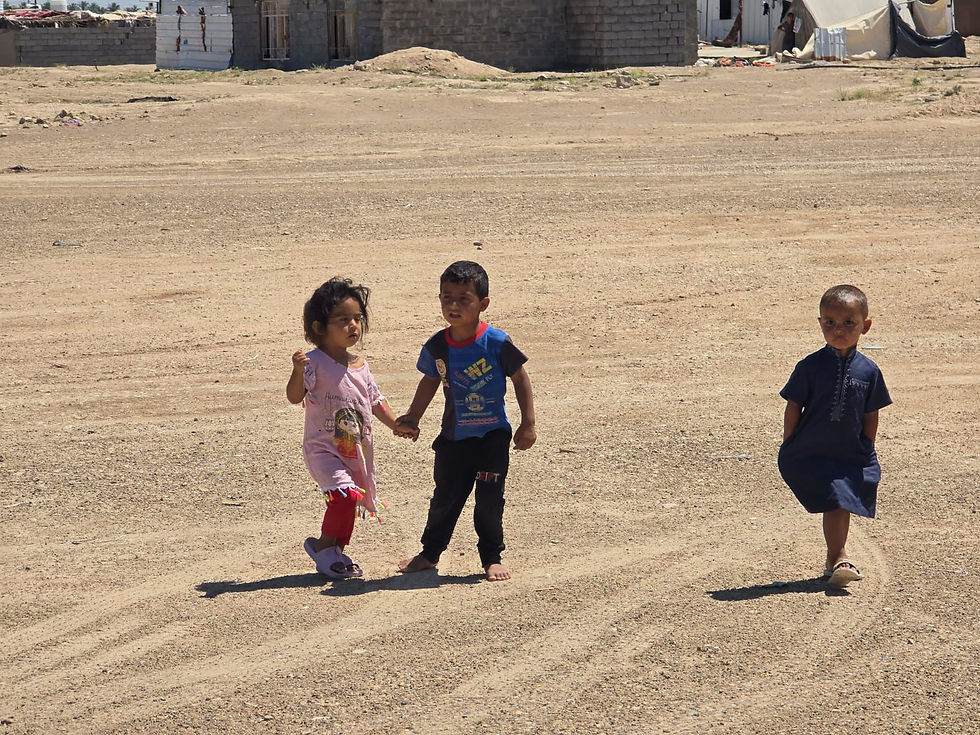
One of these communities is Bzeibiz Internally Disaplaced Persons Camp in Anbar Governorate where many families fled their homes during the 2014–2015 conflict when ISIS seized large parts of Iraq. Although active conflict has largely ended, thousands remain unable to return home because of ongoing security restrictions, destroyed infrastructure, lack of livelihoods, or perceived affiliation concerns. For many residents, temporary tents have become permanent homes.
Life in Bzeibiz is defined by uncertainty. Families endure scorching summer temperatures, freezing winters, and inadequate access to healthcare, education, and employment. Children have spent much of their lives growing up in displacement, while parents continue waiting for the opportunity to rebuild their futures.
In late March 2026, these already fragile conditions became even more severe. Record-breaking rainfall caused devastating flash floods across western Iraq and more than eight million cubic metres of water surged into the Euphrates River, flooding vulnerable communities throughout Anbar Governorate. For families in Bzeibiz Camp, the consequences were immediate and devastating: more than 650 families (exceeding 3,000 people) were affected. Around 300 tents were completely destroyed, while another 450 suffered significant damage, forcing hundreds of families to evacuate and seek temporary refuge in nearby schools. Many lost not only their shelter but also their food supplies, bedding, clothing, and everyday household belongings. Although families later returned to the camp, they returned to overcrowded and damaged shelters, often sharing the few tents that remained usable while waiting for assistance. For people who have already lived through years of conflict and displacement, another disaster meant starting over once again.

Mercy Hands' Response
When severe flooding struck Bzeibiz Camp in March 2026, Mercy Hands quickly mobilised to support families whose shelters and belongings had been devastated. The first phase of the emergency response, which occurred in late April, provided food and hygiene kits to 130 of the most vulnerable families, including essential items such as food supplies, laundry detergent, sanitary products, and diapers. This response was made possible through an extraordinary display of solidarity.
By the beginning of June, supporters around the world helped raise $3,655.81, with contributions coming from Mercy Hands staff and donors across England, the Netherlands, Germany, France, Italy, as well as generous supporters throughout Iraq via the QI Portal.
Thanks to this collective effort, Mercy Hands has been able to respond to the most urgent needs of displaced families and is now preparing a second round of distributions to continue supporting those still recovering from the floods.

Although the emergency fundraising campaign has now concluded, recovery needs continue. Many families continue to face the long-term consequences of losing their shelters and sense of security. For communities that have already spent more than a decade in displacement, rebuilding is about much more than replacing a tent—it is about restoring dignity, stability, and hope for the future.
Standing with Displaced Families
World Refugee Day reminds us that displacement is not only about crossing international borders. It is also about the millions of internally displaced people who remain within their own countries, often living through prolonged crises that receive little international attention. The families of Bzeibiz Camp have demonstrated extraordinary resilience through years of conflict, uncertainty, and now natural disaster. Yet resilience should never be mistaken for the absence of need.
At Mercy Hands, we remain committed to standing alongside displaced communities—responding to emergencies when they arise while working with communities on the long road towards recovery. This World Refugee Day, we honour not only the strength of those forced to flee but also the compassion of those who choose to stand with them. Every contribution, every act of solidarity, and every partnership helps ensure that displaced families are not forgotten—and that hope continues to reach those who need it most.


Comments